Plaque commemorates Quaker meeting house
As a new green plaque is unveiled, Kate Nicholls relates the story of Bradford on Avon’s Quaker community.
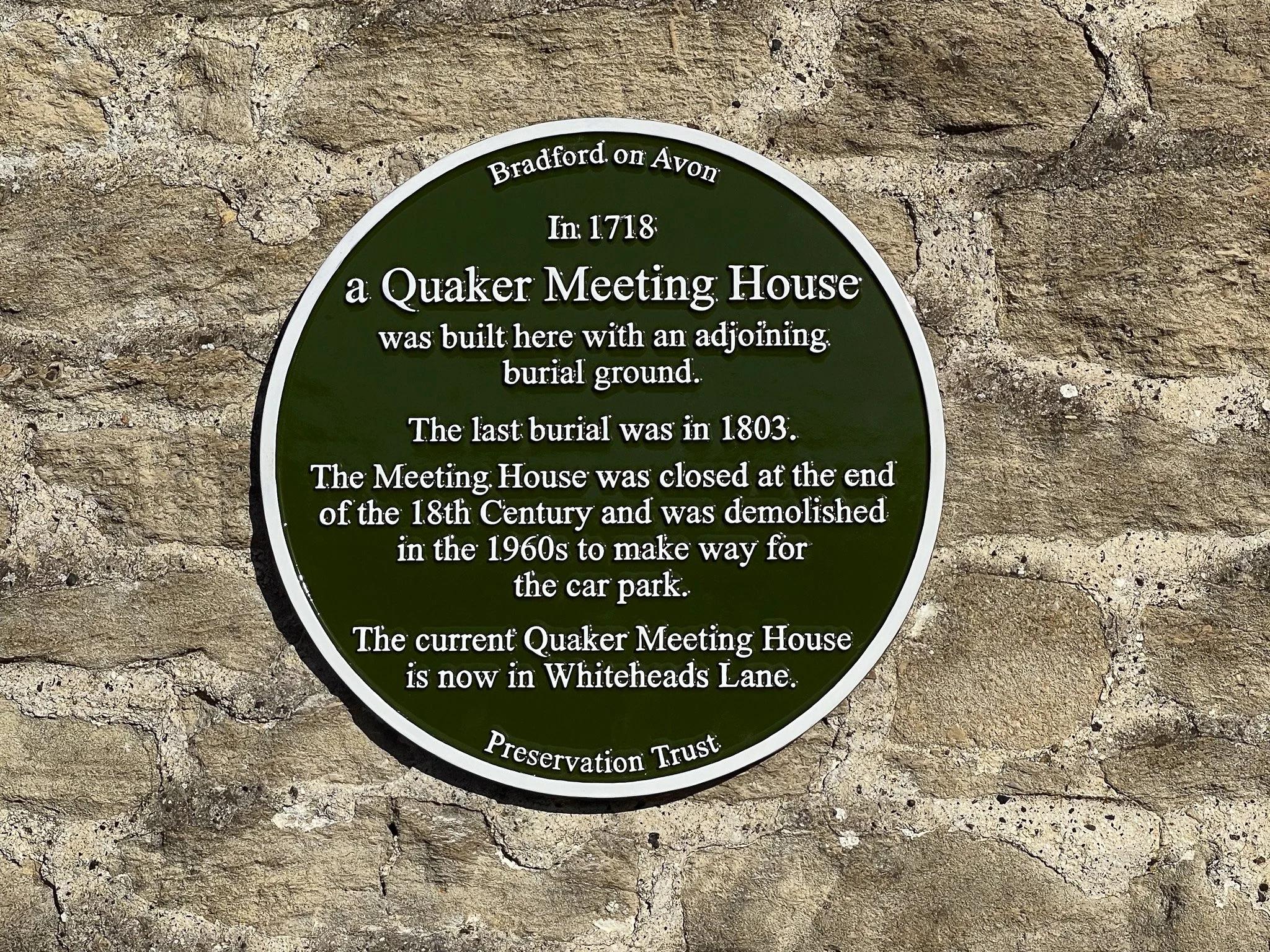
On a sunny Sunday morning this autumn, a new plaque was unveiled on the side wall of Westbury House. It commemorates a Quaker meeting house which once stood there with an adjoining burial ground.
According to Harold Fassnidge’s Bradford on Avon Past and Present, early regular Quaker worship took place at Cumberwell from 1660. Originally, probably taking place in their homes but by 1661 they had a burial ground and a meeting house had been built by 1667. After the Toleration Act of 1689 it was lawful for dissenters to meet for worship in their own way. In 1718 a second meeting house was built in the centre of Bradford – seating 200 people and costing £240. With an adjoining burial ground, it was situated in what is now St Margaret’s car park. The Quakers worshipped there until the end of the 18th century when numbers declined. The last burial was in 1803.
The building was disused for many years but around 1850 it was taken over as a British school; however, in 1880 the building was condemned and lay empty until its demolition in about 1960 to make way for the car park. Martin Valatin has produced a drawing of the likely design of the building and a map of its position. Sadly, because the burial ground was not consecrated, the bodies were not reburied elsewhere and still lie beneath the car park.
A further 170 years went by without a meeting house, until a few determined Quakers in the town undertook to look for a new one. After much searching they found an old vicarage, or rectory, in Whiteheads Lane in need of a lot of repair and renovation. After much hard work and dedication it was opened in 1971. Quaker historian Ann Warren relates: “As things transpired, we actually held our first Meeting for Worship among the weeds, sitting on garden chairs, in the garden!”
And so it was, that in early 2024, Quaker members asked the Preservation Trust trustees whether we could help to commemorate the old, lost meeting house and burial ground with a green plaque. All the trustees were in agreement, so with the help of a number of people, I undertook the project.
What was the text on the plaque to be? Where would it be positioned? What permissions would be needed? Who was going to make it?
With the help of Ann Warren, I proposed a draft text to the Quaker elders to which they made a few adjustments. So that part was quickly agreed. Looking around St Margaret’s car park with Quaker elder Gill Brooks, we settled on the side wall of Westbury House which faces into the car park and is close to the site of the demolished meeting house. Knowing the house was a Grade II* listed building, I managed to fill in the planning application forms with the help of Rosie MacGregor, chair of the Trust’s planning committee. In addition, all the residents of Westbury House had to agree. Since there was already a plaque on the other side of the building, I didn’t think we’d have too much of a problem getting all the parties to agree, which proved to be correct.
So, after planning permission was granted, I was able to order the plaque – I learned that Trust member Dick Stephens had all the information on earlier plaques, which he passed to me. The foundry still had the records of previous orders, making it easier to commission a new one. In six weeks, the finished item arrived, was fixed in position by Ian Benford and finally unveiled on 5 October by Bradford resident and Quaker elder, Dame Jocelyn Bell Burnell.
Now this lost Meeting House can be commemorated and perhaps some passers-by will be curious enough to find out more. I believe one of the Quaker community is researching the names of those buried and maybe that part of the history will be revealed in due course.
My thanks to many people for all their help: Gill Brooks and Liz Stephens who brought the idea to the Trust, Kate Larard, Rosie MacGregor, Joyce Shaw, Dick Stephens, Martin Valatin and Ann Warren.